Apparently, driving fence posts without concrete is enough to start a fight. Somebody pulls a poorly installed post out of the ground, and suddenly the whole method is junk.
Not so fast. A bad installation does not prove that driven fence posts do not work. It proves that post depth, post shape, and the right anchoring details matter.
We put that argument to the test at our Florida location, where we dug down and found sand as far as our post-hole diggers could reach. We drove posts at different depths, tried flanges and a homemade anchor, then brought in heavy equipment and a force scale to find out what it actually took to pull them out.
Some came out by hand. Others took more than 2,000 pounds of pull. The interesting part is what made the difference.
Key Takeaways
- Greater embedment dramatically improved driven-post performance in our Florida sand tests.
- Round pipe can resist pullout while still needing help to prevent rotation.
- Deeper flanges improved hand-test performance, and an anchor foot produced the highest measured pullout resistance.
- Vertical pullout results do not establish a fence system’s complete resistance to wind loads.
Table of Contents
- First, a Gate That Has Already Done the Work
- Why Test Round Pipe and an I-Post?
- Two Feet Versus Three Feet Versus Four Feet
- A Homemade Foot for Pullout Resistance
- Flanges Help, but Burial Depth Matters
- The Machine Pull Tests: From 408 to 2,230 Pounds
- What About a Post Set in Concrete?
- The Real Enemy Is Wind, Not a Giant Pulling Posts
- Build the System, Not the Argument
First, a Gate That Has Already Done the Work
Before getting into fresh test posts, we checked an installation with some history behind it: a heavy gate supported by posts we had driven about three years earlier.
Those posts had no concrete and no special anti-twist attachments. We simply drove them deep into the soil. Three years later, the gate still closed and latched, with zero adjustments.
That is a useful starting point. A gate puts more demands on its posts than just standing there looking pretty. This installation had been doing its job for years, not minutes.
It does not mean every post driven to any depth will work. It means dismissing the entire method before considering the installation details makes no sense.
Why Test Round Pipe and an I-Post?
We started with round chain-link pipe because it is the backbone of much of our vinyl fence work, and similar pipe is also used to support cedar privacy fences.
Round pipe presents a particular challenge in sand: it has no projecting shape to resist rotation. Even when it is difficult to pull straight out, it may still spin.
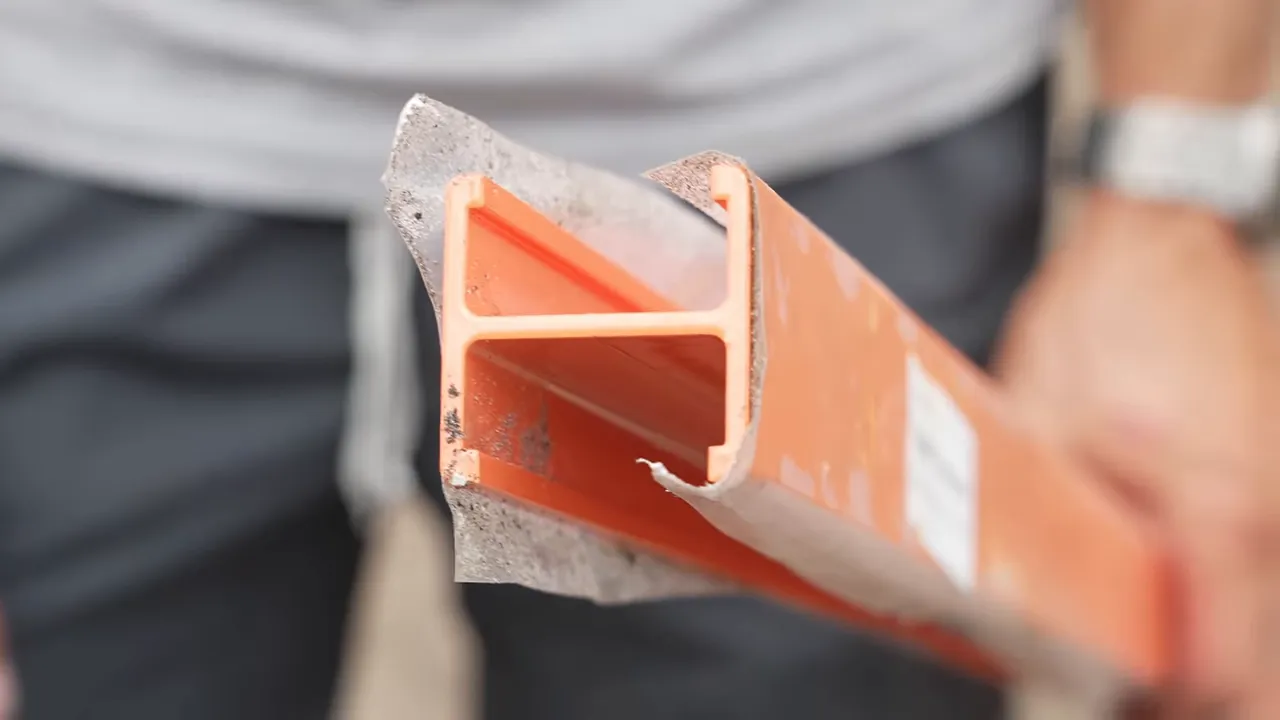
We also tested our orange I-post. Its shaped cross-section gives us a different interaction with the soil than a smooth circle does. That distinction becomes important when we compare the pull-force results.
For driving, we used a Rhino Multi-Pro. This was not a sponsored equipment demonstration. The point was that the driver let us reach the depths we wanted without much fuss, so we could focus on what depth actually changed.
Two Feet Versus Three Feet Versus Four Feet
The first question was straightforward: how much difference does another foot in the ground make?
At two feet, both post types came out
The round pipe driven two feet into the sand was easy to twist and loosen. Once I worked it around, I could pull it out by hand.
Would I want to build a privacy fence on that installation? No. Calling that a failure is fair.
The I-post at two feet also came out by hand. A different shape did not magically make a shallow installation adequate in this sand.
At three feet, the I-post changed dramatically
We drove the orange I-post another foot. Now, instead of easily removing it, I was putting enough sideways force into it to bend the post.
That extra foot made a very noticeable difference. It added very little driving time, although it did require more material.
This is one place where cutting a bid too close can hurt the finished fence. An extra foot might only represent a few dollars per post, but across a job, a contractor looking for savings may be tempted to leave it out. The ground does not care what the bid was.
The round pipe at three feet was harder to remove than the two-foot installation, but I eventually got it out. During that effort, I kinked the pipe. My interpretation was that there still was not enough surface friction to keep it buried under that upward pull.
At four feet, round pipe was much harder to pull
The round pipe driven four feet into the sand was another story. After working it hard, I managed only about a quarter-inch of upward movement.
Four feet of embedment in sand is a lot harder to overcome than two feet. But there was still another problem to solve: I could rotate the round pipe.
That is why we need to separate three different kinds of movement:
- Pullout: the post moving upward out of the ground.
- Rotation: the post spinning around its vertical axis.
- Lateral movement: the post moving or leaning sideways.
A post can perform well against one and still need help with another. Gate torque, for example, can rotate a round post and create trouble with the attached fence panel even when the post is buried deeply.
We also were not dealing with a frost-heave challenge at this Florida test site. The immediate questions were how the posts held in soft sand and how to control their movement without adding a concrete footing.
A Homemade Foot for Pullout Resistance
Next came something we had made in the shop: a small anchor foot attached to a rod. Prefabricated anchors using a similar idea are available for applications such as guy wires.
The situation we had in mind was a chain-link brace post. If forces in the fence assembly are trying to lift that post, we want an anchor working against that upward movement.
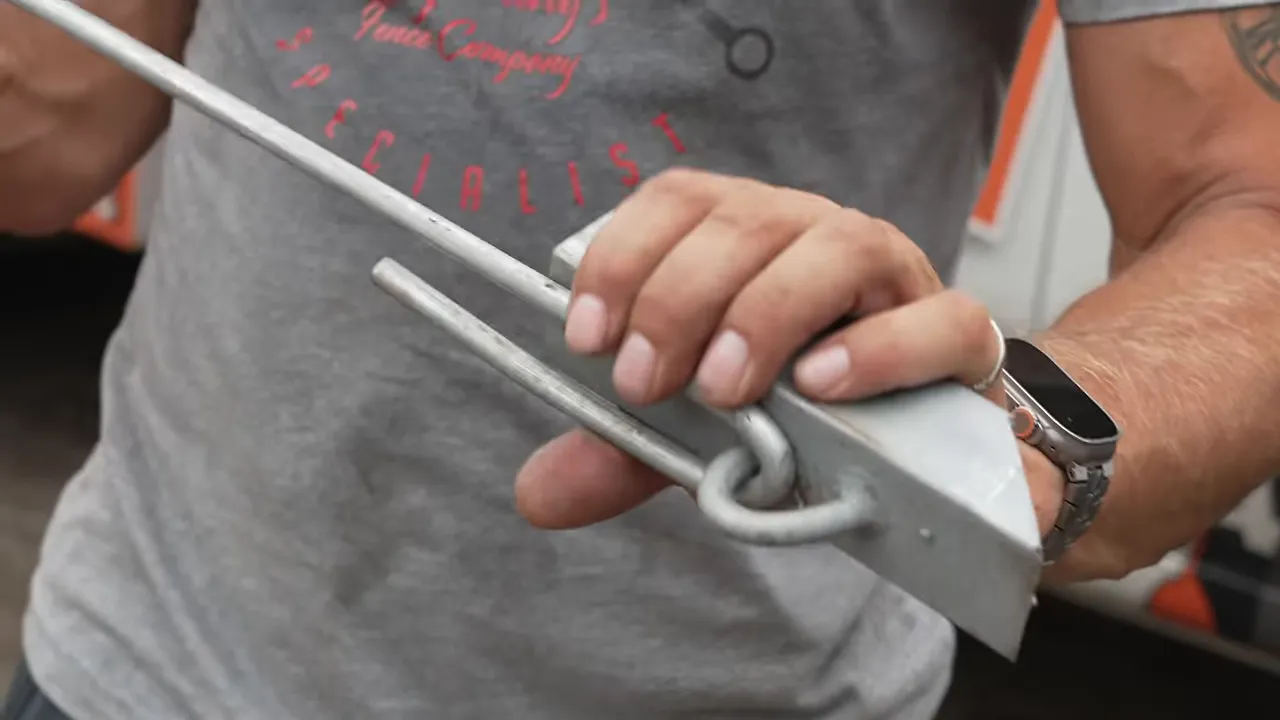
For our test, we drove the post three feet deep, drove the foot into the ground beside it, set the anchor, and welded its connection to the post. We positioned the anchor to extend away from the post in line with the imagined fence run.
Then I tried to pull the assembly by hand.
I could get some movement, roughly half an inch to three-quarters of an inch, but I could not pull it out. We left that one for the machine. It would turn out to be the strongest pullout result of the day.
Flanges Help, but Burial Depth Matters
An anchor foot was not the only option. Agricultural fence builders have used flanged T-posts for years to help posts resist movement. We wanted to apply that same basic idea to round pipe.
We welded a flange onto a pipe and tested it at three positions while keeping the total post embedment at about three feet:
- The flange just below the soil surface.
- The flange about one foot below the surface.
- The top of the flange about two feet below the surface, nearer the bottom of the buried post.
We changed the flange position relative to the buried length by cutting a foot off the bottom between tests and driving the shortened post back to three feet of total embedment.
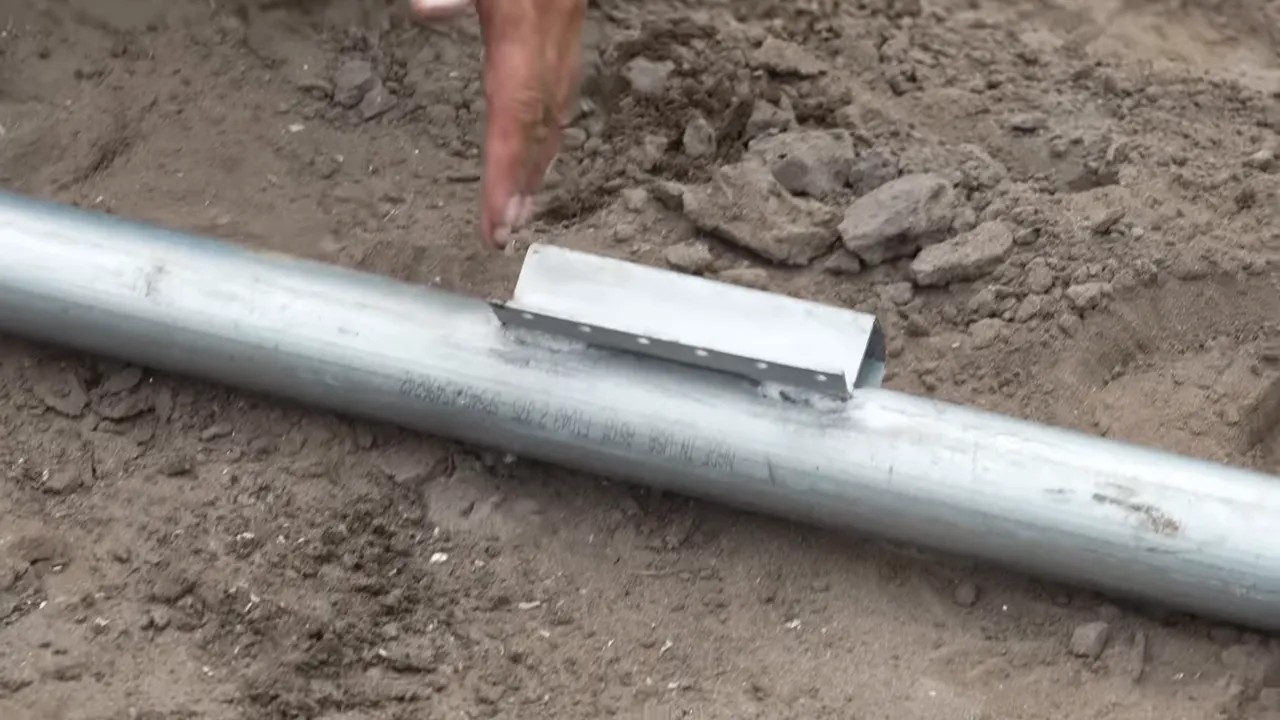
Just below the surface: still removable
The shallow flange made the pipe harder to spin than plain round pipe, but I could still rotate it. The sand near the surface moved enough to let the flange turn.
Once I loosened it, I could pull the post out by hand.
About one foot down: no spinning, but still removable
With the flange deeper, the twisting test started denting and kinking the pipe instead of rotating the buried assembly. That was a good sign for rotation resistance.
I could still pull it out, but it took considerably more effort.
About two feet down: stuck by hand
For the final position, the top of the flange was about two feet below the surface. The post still had only three feet of total embedment.
This time, I could neither spin it nor pull it out by hand. Trying to rotate it simply wanted to kink the pipe.
My original guess was that a flange about a foot below the surface might be the sweet spot. The deeper position performed better in our hand tests, although the shortened post also left me less above-ground leverage.
The lesson is not just to weld a plate somewhere and call it fixed. Where that flange sits in the soil affects how much it helps.
The Machine Pull Tests: From 408 to 2,230 Pounds
Hand tests make the differences obvious, but they do not put numbers on them. For that, we used the loader, a chain, and an inline force scale to extract the remaining posts.
Here were the recorded pullout results:
- I-post, about three feet deep, without a flange: 802 pounds.
- Plain round pipe, four feet deep: 408 pounds.
- Round pipe, four feet deep, with a flange: 933 pounds.
- Post, three feet deep, with the homemade anchor foot: 2,230 pounds.
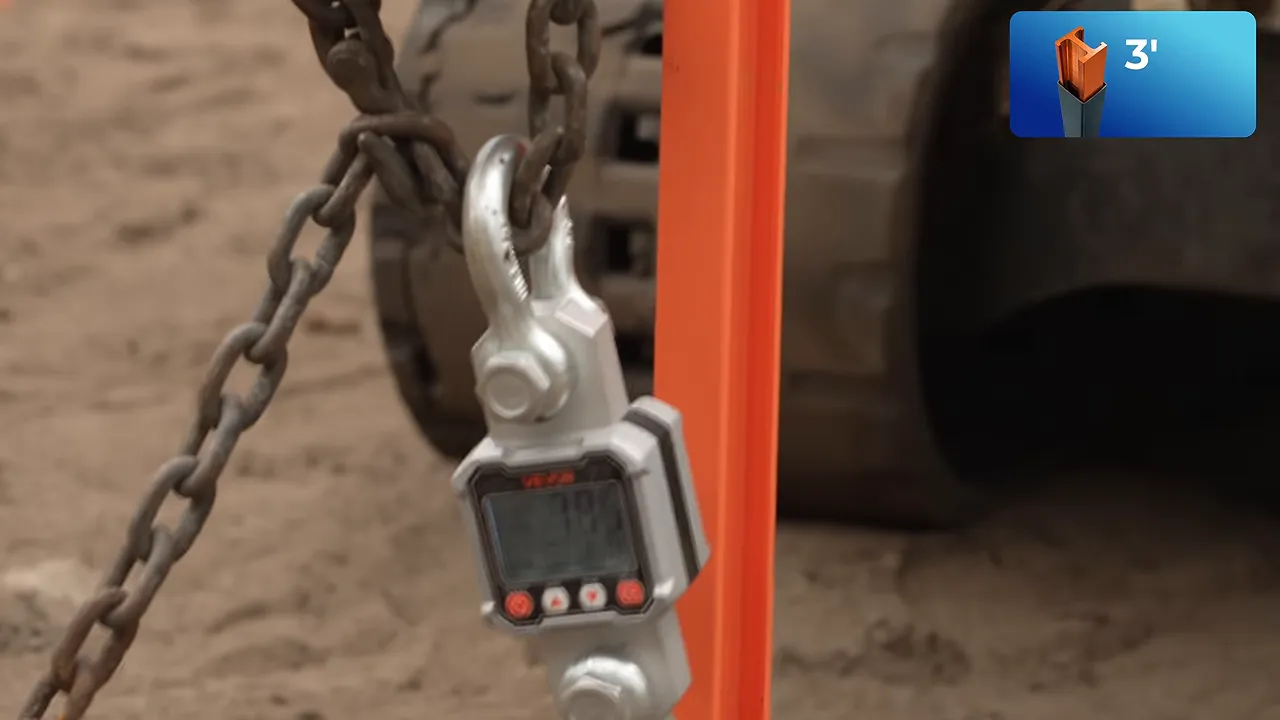
The plain round pipe and I-post were roughly comparable in overall size, but the deeper round pipe produced only about half the pullout resistance of the shaped I-post in these tests.
Adding a flange to the four-foot round pipe increased the recorded resistance from 408 pounds to 933 pounds. That is more than double from one attachment.
Then the anchored three-foot post took 2,230 pounds. That homemade foot was doing real work.
The I-post also came out in reusable condition. We had put it through a substantial pull test without leaving ourselves a concrete-covered post to deal with.
These are results from the specific posts and conditions we tested, not universal design capacities. They show how much the details can change performance, even within the same sandy test area.
What About a Post Set in Concrete?
We also tested a conventional aluminum fence post set in a shallow concrete footing, in the roughly 18- to 24-inch range discussed during the comparison.
That assembly took 534 pounds of pull to extract, compared with 802 pounds for the I-post driven about three feet into the sand.
That is an interesting result, but the concrete installation needs an important qualification: we had dry-packed it the previous day, and it had only about 24 hours to cure. It was not a comparison against a fully cured concrete footing. The American Concrete Institute provides additional context on concrete curing.
The conventional aluminum post was also easy to bend or break during our handling comparison, while I could not produce the same failure by hand with the I-post.
What does that prove? It shows that adding concrete to a shallow installation does not automatically make it stronger than a deeper driven system. It does not prove that every concrete footing will perform worse.
The Real Enemy Is Wind, Not a Giant Pulling Posts
Pulling posts out with a loader is useful, but Godzilla is not roaming Florida yanking fences straight out of the ground.
Wind pushes fences sideways. That is the everyday problem we are trying to combat.
So, while these pull tests tell us something useful about anchorage, they are not a complete wind-load test. A fence also needs to resist lateral movement, post bending, rotation, and problems at its connections.
Our practical lessons from this Florida sand test are straightforward:
- Do not skimp on depth. Two feet was inadequate for the posts we tested in this sand.
- Match the post shape to the job. Smooth round pipe and a shaped I-post did not behave the same way.
- Address gate torque. A post that is difficult to extract may still rotate.
- Place flanges where they can work. A flange just under the surface was less effective than a deeper one.
- Use anchoring details when uplift is a concern. Our homemade foot substantially increased pullout resistance.
That is the difference between defending a method blindly and making it work correctly. We are not saying every driven post is a good installation. We are saying concrete is not a substitute for understanding depth, soil, post shape, and the forces acting on a fence.
Build the System, Not the Argument
A shallow post that comes out by hand is a reason to improve the installation, not condemn every driven fence post.
In this sand, another foot of depth changed the I-post dramatically. A flange helped round pipe resist rotation and increased its measured pullout strength. A separate anchor foot pushed the result past 2,000 pounds.
Those are practical tools, not magic tricks.
Our orange I-post is part of the I Fence no-dig aluminum system, and these results are why we believe in that approach. If you are considering aluminum fencing, you can take a closer look at the system and the driven posts behind it.
|